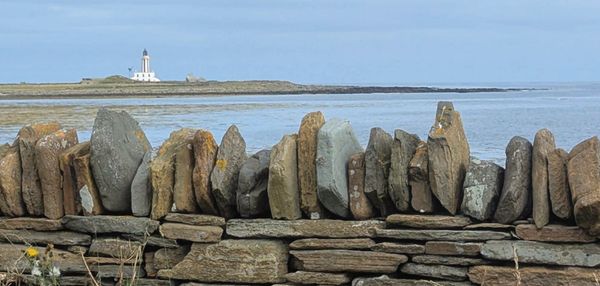
The Holms of Ire
I'm nearing the end of the Granta course on Nature Writing and I've given myself the challenge of writing a sequence of poems that connect to the Holms of Ire, the two tidal islands north of Burness on Sanday. Coincidentally, there's some problem with the cable that provides fibre internet to our homes, so it might turn out to be quite a writing retreat for the next couple of weeks!
As an introduction to that, here's a piece I wrote for my book, Rag Stones, which talks about learning to work with stone. If that's your thing, it's available via the Orcadian bookshop. In the meantime...
The Setting of the Skull
On the first bright day of Spring, when the tides are kind and align, the dogs and I set out on what’s become something of an annual ritual.
From Airon, we walk on the low, exposed shore past the Ebb and the Hole o’Airon, its strangely circular pool exposed by low water. We turn around the Inner Geo, at the leftmost point of Roo’s Bay, and around to Yorstan’s Geo where we once found a stray kitten and on past the beautifully named Skeebanks, Furrowend and Iron Geo until the land to the west yields from grass to exposed stone.
The dogs loiter at Whal Geo, hoping that we will not turn back, but head out to the Holms of Ire, the tidal islands to the north of Burness. Whal Geo gained its name as a perfect spot for driving a pod of whales into peril. Men would scramble to sea in their small boats, with the clamour of metal pots and pans to join their shouts and curses. They’d baffle, hassle and threaten the whales until their hefty bellies caught on the shallow stone or were trapped in the narrow nook of the Dog Pow, a short spit of land that makes a small pool. Most likely, they mainly drove them onto the shores of the Inner Sound or the slope of Whal Geo itself. There, they’d meet their doom. Bands of women waited in thick skirts and heavy boots with cudgels and staves in their strong hands, wet with salty sea and greasy death.
Dogs care little for the bloody gutters of history and race instead across the bubble wrap pop of bladderwrack. I step with a swagger, test and plant each step on sand, shingle stone and popping seaweed. My heel hooks into the natural step of sandstone for balance and I plod into water, quickly remembering the age of my weathered wellies.
Then, up the steep bank where grass fills the bellies of lost creels and a single slip, cut by time, rides up to the Inner Holm. My gait switches and I find myself facing the leaning stone wall of what may have once been the old chapel to Saint Columba. I know that the name predates the Viking Norse, but I can’t help but feel the urge to say “Just one more question!” as I straighten the skirt of a trenchcoat and raise the eyebrow of my one good eye.
But I’m no detective. I fail to interrogate history seriously.
Someone’s built a small marker cairn - just three or four feet in height - amid old ruins made with surprisingly upright flagstones. I don’t know how old anything is. That’s the beauty and the riddle of stone buildings. The stone predates the hands that shift it, like Lego blocks, from one use to the next as their needs change.
The dogs sniff the odd ruin that still stands. Three walls straight, one curved in a semicircle. Another candidate for the old chapel. I don’t linger, although I do remember how many times Rona had to repeat the word steeth to name the low walls built from beach rocks on which kelp was set to dry. Several of these dot the Inner Holm. Old words, old worlds and ever-new ways. We build, we fall, we build again. A species whose hands yearn to stack one stone upon another.
Deep ruts mark the point where, one autumn when Willie Deerness had sheep on the Outer Holm, his tractor got stuck in the mud. It was so stubbornly set in its place that it resisted all attempts to shift it and blocked the path for other vehicles to pass. The resilient sheep spent the winter on the Outer Holm, wild on their own island. A series of planticrues dot along the western side of that track. Circular buildings made, of course, of dry stone, about two metres or sixish feet across inside. For years, I imagined they sheltered sheep or had been nonsensical saunas or emergency huts. Now, I know they were a great place to keep your seed cabbages over the winter, nested in straw.
The dogs and I arrive at the cairn at the end of the Inner Holm. Like its kin, it stands tall and solid, a beehive bulge in the middle but without the slight lean that’s crept back into the one at the top of Whal Brae. Creels and ropes reinforce its base, knitted through with strong grasses. I think the sometimes-land, sometimes-sea stretch between the Holms is an easier proposition than the first crossing. But perhaps the seaweed has just dried in the time it’s taken to cross the first narrow island. There’s one crag where I sometimes see rats among the mallimacks, braving their acrid spit to feast on eggs and chicks.
A blackback swoop-soars. Its wings black falchions, belly bright as cloud in summer.
The Outer Holm is a kingdom of geese. The chaldro and the mallimacks dot through the boggy grass and brown ducks erupt as you approach, but the geese rule even if, in summer, the cooter-nebs pleep and dit on the western cliffs. To the right, a large lochan. Deeper than a boot in winter and a wet mess still in summer. I loop left, towards the cliffs. The dogs and I follow the lichen-white of an old, collapsed wall that flows the arc of the egg-shaped island. And there, at the end of the green land the marsh of another lochan. This one, late in the year, erupts into chamomile. Right now, it’s speckled with a dusting of green.
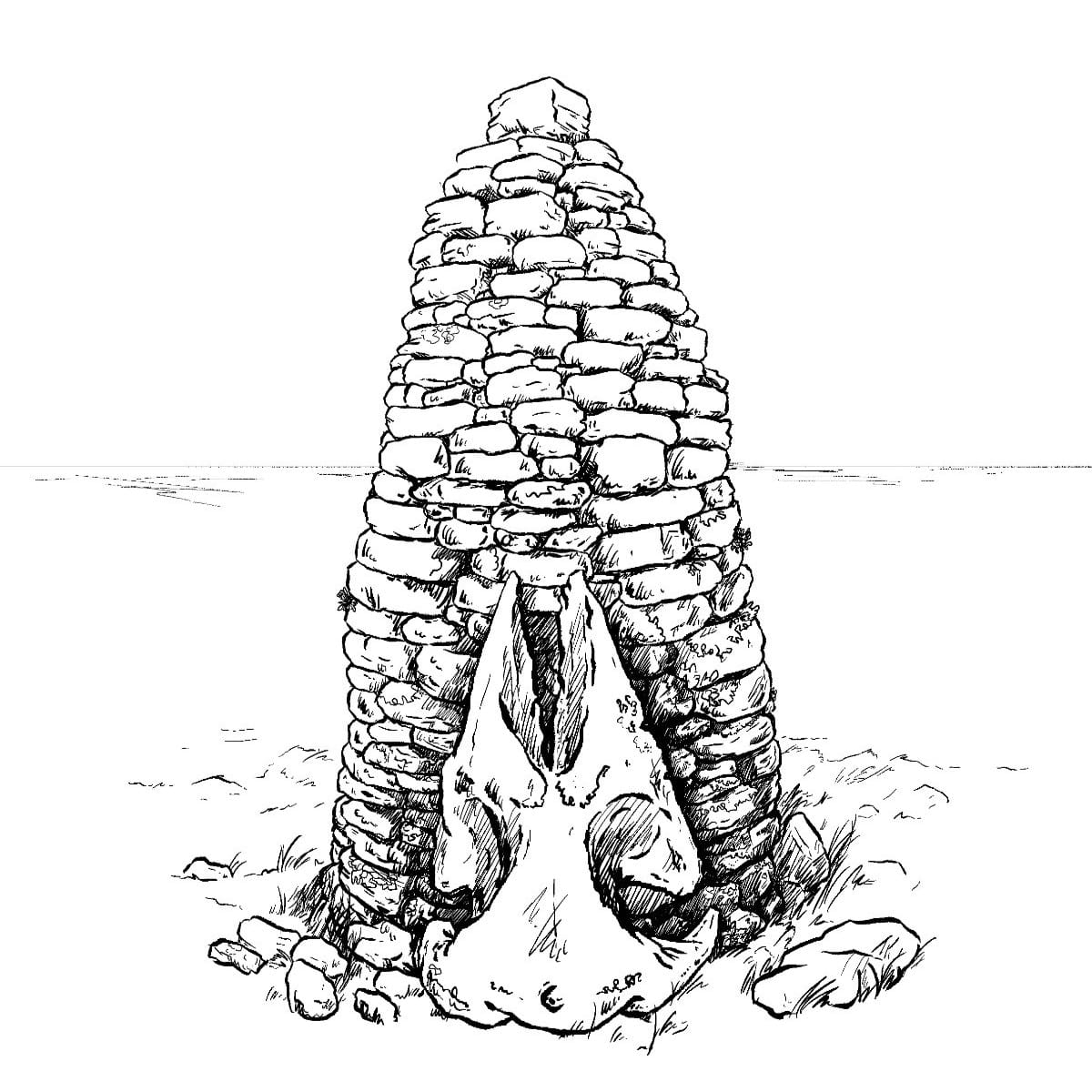
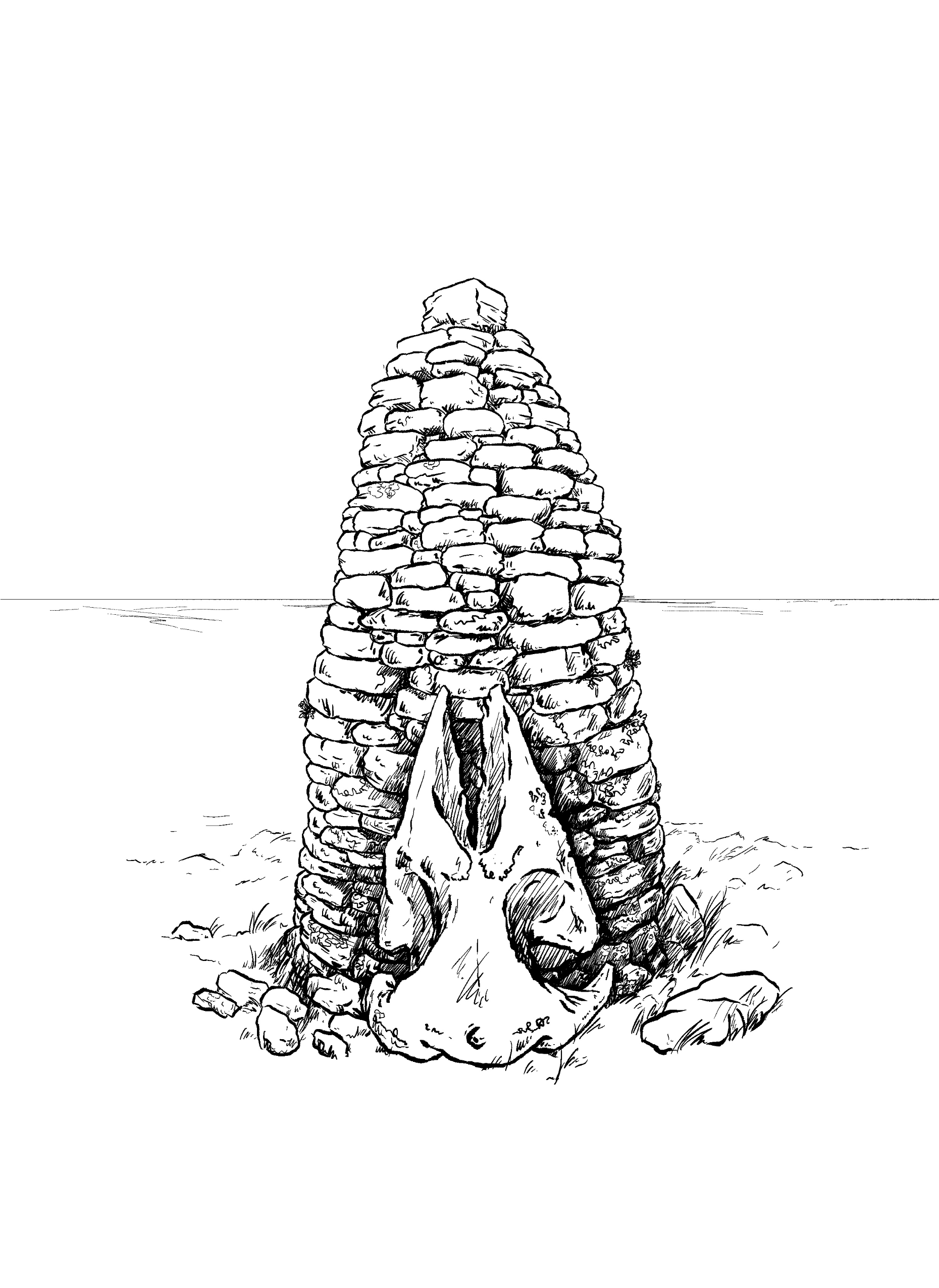
And then, the last cairn. Tall and broad, the perch of a stubborn blackback whose eyes track the scampering dogs.
At its base is the grey skull of a pilot whale. It’s been dead long enough to lose the lustre of enamel and to instead become peppered by lichen and bare holes. Its left eye socket has broken. It reminds me of the frightening x-rays of my own skull after an attack that broke my cheekbone and the side of my eye socket. It still works as a barometer, but is otherwise another forgotten injury, unlike this dead beast, eyes long gone, bone break exposed to the decades. I assume it broke long after its death, as - unlike mine - the injury shows no signs of healing.
In Orkney folklore - which means it is entirely true - the seasons are a battle between the Mither o’ the Sea and the Muckle Meister Stoor Wurm, the angry beast killed at least once by Assiepattle, its bones and teeth forming the islands of this part of the North Atlantic, its burning liver forming Iceland. The beast’s rule over the thrashing waves of winter’s black seas ends in spring, when the Mither returns from her autumnal death to nurture the calm, grey-green waters. It is to her that I consider this trek sacred.
I put on the gloves I use for gripping dyke stones and I lift the heavy skull with both hands. I set it so it rests where the skull meets spine, just below its blowhole. The long stretch of sinus lays on the cairn, the wounded eyes once more looking up to the skies. These cairns are not here to mark the dead. They’re here to save the living. On the far side of the bay, a reef sits dangerously close to the surface, scraping or splitting the hull of ships in new waters. Beyond the Holms is a graveyard of iron.
There is a safe route into Roo’s Bay, and these cairns are its key. Willie Deerness telt me that from the sea, each cairn lines up in its turn with the peaks of distant hills on other islands. Westray, Rousay, the mainland. Following this system, a boat can skirt the dangers of the shallow riv and reach shelter and safety at the nousts of Airon, Bayview and Nouster. There, creels would come ashore or travellers return home.
The skull is set for the Mither o’ the Sea. Like the tracing of the cairns: an act of faith, rewarded.