Barbara Fea in her own words
I've had a pretty full-on week! From Monday until Wednesday, I was on a course that taught folk from Orkney's museums and heritage groups about how to manage, protect and care for the objects in their collection and then I spent Thursday in the archive, greedily working my way through hundreds of documents that I'm just starting to get into.
I recently read Peggy Fea's An Orkney Family Saga which traces some of the most dramatic stories attached to folk with the Fea name. She talks about Barbara's "fiery" father, Patrick, the privateer whose violence against Dutch trading vessels earned him enough money to build Whitehall in Stronsay. Unfortunately, he brought that violence home with him and was often fined for his shocking violence, including beating William Gunn so badly that the servant was injured so badly that he could no longer work and became a destitute beggar.
When she writes about Barbara, she's painting a picture of a woman who inherited her father's (and her mother's, but that's another story) capacity for fury and violence. Unfortunately, she has to rely on Hugh Marwick's The Merchant Lairds of Long Ago which collects the letters sent between the Traill family, her sworn enemies. Marwick's edits, I'm finding out, are exceptionally kind to the lairds and omit their conspiring and their deceit and their fears.
It seems like a painful pity that Barbara Fea is remembered through the letters of her enemies and abusers. Her relatives, through history, have seen her as this sexually aggressive, violent and litigious gold-digger. She's the "Base, lying whore" that Patrick Traill describes.
I want to know her side of this story. That's why I'm spending so many hours going through court records, letters and kirk documents to try to piece together her tale.
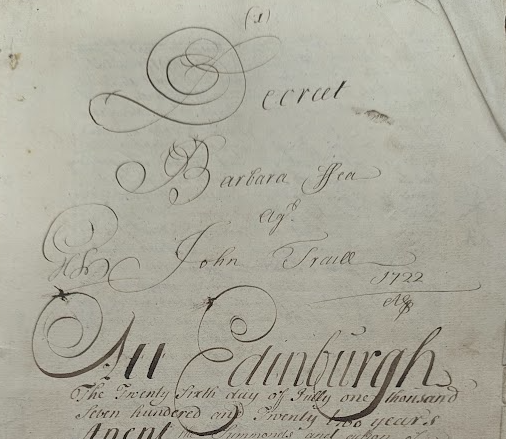
Yesterday, I read a court document from 1722 that talks about how Patrick Traill, as a young man, bedded Barbara Fea while she was at school and their parents were away, wooing her with false promises of a marriage he knew would never happen. It was enough of a shock that when I asked the archivists to check a word (we think it says Edinburgh), more or less everyone in the archive put down their research to comment on Barbara's awful position.
Frustratingly, I can't find exact dates for when his pursuit began and what age she was, but I have a feeling that the Traills consistently lied about Patrick's age. If he were, as they say, 17 when it began, then this account of his being six years older than her would have made her 11. I've seen his baptismal record, and he was baptised on the 8th of October 1679. Jean Traill was born to Barbara Fea in 1702, which would make him 22 or 23. That would mean he'd been pursuing Barbara for five years by that time.
If she had been 16 when the child was born, it doesn't sound right that she's described as exceptionally young and a "girl" or "lass" rather than a young woman in court records. Something isn't adding up just yet.
Finding Barbara's Voice
The challenge, all along, has been to find Barbara in her own words. When she's young and manages to persuade the Lord Advocate in Edinburgh to press Patrick Traill into marriage, she's warned that it could lead to the ruin of both families. She assured him : "I'll take the hazard of that."
In another document, she complains that she is "Caught between one hand and the other," unable to go to her husband for money to live on because his father will disown him and unable to ask her father-in-law for a living because he says it's her husband's duty.
By 1722, the case has been running for twenty years since the marriage was signed. When she appears as a witness, she speaks as a lawyer would. She cites acts of parliament and Latin principles of jurisprudence. She appeals to the law of natural justice and of Christian duty. She argues with logic and challenges the flaws in John Traill's dogged refusal to recognise her as his heir's wife.
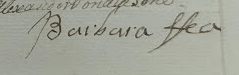
Her intellect is as formidable as her tenacity. When Patrick dies, she issues legal letters in her own hand, but in later documents, she relies on another to scribe and her signature becomes shakier. I wonder if the awful injuries she suffered in her youth returned to haunt her bones in adulthood.
I have yet to find personal letters, though. She wrote often in pursuit of debts or to query matters of law, but I hope that as I go through the hundreds of documents I photographed yesterday I get to see her in happier moments. She clearly inspired loyalty in so many people, with servants of the Traills risking everything to testify in her favour.
I'll get back to that now, but I'm hoping to learn more about the lives of the "Bonnet Lairds", those smaller landowners who still had mud, kelp or blood under their fingernails at the end of the working day.
My curiosity about one clear injustice means I'm having to learn so very much about so many things. But my drive to tell her tale from her view remains.